
Recovering Facial Function 18 Months Post Vestibular Schwannoma Excision: A Neuro-Rehabilitative Case Study
Sanlap Kundu1*, Sarasij Bit1, Patralika Nath1
1Department of Physiotherapy, National Institute for Locomotor Disabilities (Divyangjan)
* Corresponding Author: Sanlap Kundu, Department of Physiotherapy, National Institute for Locomotor Disabilities (Divyangjan)
Received: 25 December 2025; Accepted: 31 December 2025; Published: 03 January 2026
Article Information
Citation:
Sanlap Kundu, Sarasij Bit, Patralika Nath, Recovering Facial Function 18 Months Post Vestibular Schwannoma Excision: A Neuro-Rehabilitative Case Study. Archives of Physiotherapy and Rehabilitation. 9 (2026): 09-13.
View / Download Pdf Share at FacebookAbstract
Introduction: Vestibular schwannoma, or acoustic neuroma, is a benign tumor that affects the eighth cranial nerve, which often results in hearing loss, tinnitus, and balance issues. Surgical removal can lead to post-operative complications such as facial nerve palsy that can significantly impact a patient's quality of life.
Case description: This case study presents the rehabilitation of a 51-year-old female who developed right-sided facial palsy following a right retromastoid suboccipital craniotomy. Eighteen months post-surgery, she sought rehabilitation with complaints of facial asymmetry, difficulty in speech, chewing, swallowing, and incomplete eye closure.
Intervention: A tailored rehabilitation program was implemented, which included neuromuscular re-education, facial PNF exercises, mirror biofeedback, faradic stimulation, facial taping, and postural care. The patient also received interventions for tremor management and lower limb strengthening.
Outcome: Within four weeks, she demonstrated improvements in facial symmetry, eye closure and functional facial expressions, which was also evidenced by improved scores on the Sunnybrook Facial Grading System.
Conclusion: This case highlights the effectiveness of targeted physiotherapy in post-surgical facial palsy rehabilitation after the removal of vestibular schwannoma. A multidisciplinary approach that combines neuromuscular re-education, electrotherapy, and functional training can accelerate recovery and enhance the patient’s overall quality of life.
Keywords
<p style="text-align:justify"><span style="font-size:12pt"><span style="font-size:10.0pt"><span style="color:#212121">Vestibular Schwannoma; Acoustic Neuroma; Facial Palsy; Physical Rehabilitation; Neuromuscular Re-education; Facial Taping</span></span></span></p>
Article Details
Introduction
Vestibular schwannoma (VS) is a benign Schwann cell tumor that typically arises from the inferior division of the vestibular nerve due to the loss of a tumor-suppressor gene on chromosome 22, occurring as a somatic mutation in sporadic cases or as an inherited or new mutation in neurofibromatosis Type 2 (NF2). VS are common intracranial tumors, accounting for 8–10% of cases, with an annual incidence of approximately 1.1–1.5 per 100,000 people. Tumor symptom correlates with size, starting with hearing loss, tinnitus and balance issues which ultimately leads to progressive facial numbness, weakness and brainstem involvement as it enlarges [1]. In large acoustic neuromas (> 4cm in diameter); surgery risks facial nerve dysfunction as the nerve becomes thin like a membrane [2]. The primary objective of the treatment includes tumor resection along with preservation of facial nerve [3]. However, the postoperative complications of acoustic neuroma surgery may include facial paralysis, cerebrospinal fluid leakage, meningitis, and, in rare cases, mortality [4]. From the patient’s perspective, facial nerve paralysis is the most debilitating complication of acoustic neuroma [3]. The incidence of facial nerve dysfunction following vestibular schwannoma resection has significantly declined with the widespread implementation of microsurgical techniques. Early postoperative facial nerve management includes surgical repair, corneal protection, delayed nerve substitution, and physiotherapy-driven neuromuscular retraining using mirror biofeedback, electromyography and relaxation techniques [5]. This case study aims to highlight the effectiveness of a tailored, multidisciplinary rehabilitation program for post-surgical facial palsy in a 51-year-old female vestibular schwannoma patient.
Patient Information
A 51-year-old right-handed female presented to the clinic with complaints of right-sided facial weakness persisting for eighteen months following surgical excision of a vestibular schwannoma. She had undergone a right-sided retromastoid suboccipital craniotomy for tumor removal. She reported difficulty with facial expressions, speech, chewing, swallowing, and incomplete right eye closure. Additionally, she experienced right lower limb weakness with gait disturbance and involuntary movements in the right-hand while grasping any object. This was a marked decline in her functional independence and quality of life. She also reported emotional distress and social withdrawal due to facial asymmetry. She had no prior history of hypertension, diabetes, or thyroid disorders, though she led a sedentary lifestyle. Beck’s Depression Inventory indicated severe depression.
The patient had undergone home-based physiotherapy with minimal improvement before seeking rehabilitation in our hospital. Now, as she visits our hospital, she intended to improve facial function, regain symmetry, and enhance her overall quality of life.
Timeline of Events
The patient initially presented with walking difficulty and hearing problems in February 2022, later developed additional neurological symptoms like – headache, tinnitus and slurred speech. MRI revealed a right cerebellopontine vestibular schwannoma (Figure 1), for which she underwent ventriculo-peritoneal shunt placement and subsequent retromastoid suboccipital craniotomy with total tumor resection. Post-operative complications included shunt extrusion requiring its removal, with ongoing follow-up and rehabilitation continuing into 2024.
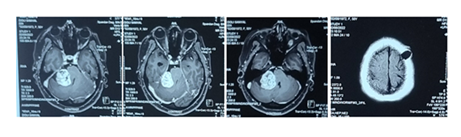
Figure 1: MRI Findings
Clinical Findings
On observation, we found that the endomorphic patient was able to walk on her own but assistance from a person is required sometimes for prolonged walking. We observed intentional tremor in her right hand which had a TETRAS score of 2 for upper limb and 3 for handwriting. The patient exhibited forward head posture with increased cervical lordosis, left shoulder elevation, protracted shoulders, reduced thoracic kyphosis, decreased lumbar lordosis, and slight left pelvic elevation. The patient exhibited facial asymmetry with deviation towards the left and a decreased right nasolabial fold. Three healed scars were noted on the retromastoid, Keen’s point, and left hypochondriac regions, along with a non-tender calcified sebaceous cyst in the left high parietal area. Higher mental functions were preserved except for right-sided hearing loss and slurred speech, with an MMSE score of 27. On examination of the cranial nerve, we found that the patient had hyperalgesia and decreased touch and temperature sensation in the ophthalmic, maxillary, and mandibular divisions of the right trigeminal nerve, along with mild weakness of the right temporalis, pterygoid, and masseter muscles. Examination of the facial nerve revealed impaired facial expression (Figure 2), absent right nasolabial fold and facial deviation to the left with positive Bell’s phenomenon. Auditory testing using a 512 Hz tuning fork indicated complete nerve deafness in the right ear. There was no significant abnormality found on cardiorespiratory examination; however, patient complained of fatigue with prolonged walking. Sensory examination revealed no abnormalities in superficial, deep, or combined cortical sensations in either upper or lower limbs. Reflex examination showed a normal plantar reflex with flexion of the toes. Deep tendon reflexes were slightly diminished on the right side compared to the left, particularly in the biceps, supinator, and ankle reflexes. Muscle tone was normal in all extremities. The patient demonstrated decreased active range of motion in right hip flexion (85°), right hip abduction (35°), and right knee flexion (142°) compared to normal values, while passive range of motion remained within normal limits. Muscle strength assessment using the modified Oxford scale revealed weakness in the right hip flexors and extensors (grade 3+), and right hip abductors (grade 3) prior to rehabilitation.
The patient maintained normal bowel and bladder control and satisfactory bed mobility. Balance was generally good in sitting and standing, with mild difficulty picking objects off the floor, standing on one foot, and walking backwards. Coordination tests showed mild to moderate impairment, particularly with eyes closed and in alternating or complex movements (e.g., alternate nose to finger). Gait assessment revealed a Trendelenburg gait, decreased arm swing, and increased out-toeing.
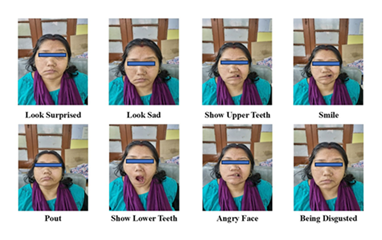
Figure 2: Facial expression
Provisional Diagnosis
The 51-year-old female patient was experiencing delayed complications following vestibular schwannoma, including facial palsy, right-sided hearing loss, mild trigeminal nerve palsy, and impaired coordination.
Physiotherapy Management
Table 1: Gives a detailed physiotherapy plan for the patient.
Table 1: Physiotherapy plan for the patient.
|
For treatment of Facial Palsy |
|||
|
Intervention |
Rationale |
Strategy |
Regimen |
|
Facial PNF exercises |
To re-educate the weak facial muscles |
Facial PNF techniques were used for Epicranius, Corrugator, Orbicularis oculi, Levator palpebrae superioris, Procerus, Risorius, Orbicularis oris, Levator Labii Superioris, Mentalis, Levator anguli oris, Depressor anguli oris, Buccinator, Masseter temporalis, Infrahyoid and Suprahyoid muscles. |
10 repetitions for each muscle group, once daily |
|
Faradic Stimulation |
To maintain muscle properties and stimulate the weak facial muscles |
Surge faradic stimulation was given to the weak facial muscles. |
30 visible contractions per muscle, once daily |
|
Facial Massage |
For relaxation purpose |
Firm pressure was used in the weak facial muscles with the pads of the therapist’s finger. |
Once daily |
|
Facial Taping |
Helps to maintain facial symmetry |
4 strips were used on the right half of the face with 15% stretch. |
Once daily |
|
Mirror biofeedback exercises |
To actively strengthen the facial muscles |
Specific exercises were taught to help coordinate both sides of the face – |
10 repetitions for each exercise. 3 times per day; once infront of the therapist 5 times per week and rest as home exercise program everyday |
|
Patient education on eye care |
To protect the eyes from dryness |
Following advice were given – |
Patients were asked to follow the advice regularly. |
|
For mild trigeminal nerve palsy |
|||
|
Sensory re-education |
To re-educate the sensory system |
Sensory re-education techniques using cotton, clothes of different textures etc. |
10 repetions with each substance, twice daily. Patient was also asked to perform this daily at home. |
|
Massage to the muscles of mastication |
To relax the muscles |
Masseter: Therapist placed the fingers just below the zygomatic arch and slightly pressed the fingers inwards. Then the fingers are moved slightly downwards along the length of muscle to the mandible. |
Once daily |
|
To improve lower limb weakness |
|||
|
Resistance exercises for lower limb |
To improve strength of right hip flexors, abductors and knee extensors |
Weight cuff of 1kg was used to strengthen these muscles first in lying and then in sitting. |
10 repetitions for each exercise |
|
To improve Co-ordination |
|||
|
Multi task activities |
To improve hand-eye skills |
Patient performed following exercises – |
10 repetitions for each exercise, once daily |
|
Otago Home Exercise Program |
To improve balance and co-ordination |
A set of exercises were given to the patient in the form of a leaflet and then the patient was instructed to the exercises twice daily. |
Patient was asked to perform the exercises regularly at home. |
|
To improve tremor |
|||
|
Weight bearing exercises |
To decrease the events of shaking of hands |
Right upper extremity weight bearing in sitting position. |
3 minutes for weight bearing and later 10 repetitions for resistance exercises |
|
For postural impairment |
|||
|
Patient education |
To be aware of the patient and maintain correct posture during different activities. |
Correct facial posture, forward head posture and overall faulty posture |
Patients were asked to follow thadvicees regularly. |
Outcome measures and Improvement List
Physiotherapy was administered for one month, five days a week, with outcome measures recorded before and after the intervention (Table 2). Additionally, pre-treatment assessments included a Facial Nerve Grading Scale 2.0 score of 19 (Grade IV) and a Neuropsychiatric Inventory Questionnaire (NPI-Q) score of 20 for severity and 32 for caregiver distress.
After one month of treatment, the patient showed noticeable improvements in facial symmetry, eye closure, lacrimation, and reduction of tremors. Her lower limb strength also increased. The patient can now display her lower teeth on command, indicating better facial muscle strength. Additionally, she feels more encouraged and happier, reflecting an improvement in her depression score.
Table 2: Outcome measures
|
Outcome measure |
Pre-rehabiliation Score |
Post-rehabilitation Score |
|
Sunnybrook Facial Grading System [Composite Score] |
3 |
33 |
|
Timed Up and Go Test (TUG) [seconds] |
19.3 |
15.6 |
Discussion
Facial palsy following vestibular schwannoma resection is a common occurrence and may present as immediate or delayed complaint. Whether the degree of involvement of facial nerve is related to size of tumor, surgical approach and/or age of patient is not clearly established with various literature favoring or rejecting the probability [6-8]. The most common causes have been linked to edema, vasoconstriction and delayed suspected viral reactivation [9,10]. Delayed facial paralysis presents with a characteristic lag of 5-30 days post-surgery. As such, these cases are difficult to follow and keep track of once patients are discharged. To complicate things further, pre-surgical and immediate post-surgical scores of facial functions are seldom recorded. In our case study, our baseline data was collected 18 months post-surgery and there was no data available which could provide information about the nature of paralysis in the preceding 18 months. While researching available literature on the recording of facial function, one is confounded by the sheer diversity of scales used ranging from House-Brackmann Grading System, Sunnybrook Facial Grading System, Facial Disability Index to FACE scale. As such comparison between studies and best approach based on baseline scores may be difficult to form. Our patient also had additional concurrent complaints of a tremor, the root cause of which we failed to arrive at. Though a Holistic approach is needed to treat these type of patients, regular physiotherapy is already proved to be effective for re-educating and strengthening weak facial muscles, improving functional independence, and to improve quality of life, there's no study conducts patients who attends physiotherapy 18 months after post-surgery. Apart from the physiotherapy interventions used by us, self-videography-replay and EMG biofeedback training are promising avenues that in turn give patients direct control and feedback [11]. As far as best practice is concerned, early detection and early administration of structured physiotherapy regime tailor-made for each individual should be followed to avoid the development of synkinesis. To reduce the difficulties of travel, time and cost incurred by patients, a home exercise regime may be beneficial but should be advised by the physical therapist based on the facial function scores.
Conclusion
It is evident that even after an intervening period of 18 months, following a tailored Physiotherapy plan targeting the different aspect of symptoms could improve the existing problems in a 51-year-old female with facial palsy from vestibular schwannoma surgery.
Disclosures for all authors
- Conflict of interest: The authors report no conflict of interest.
- Funding details: The author’s report there was no funding to declare.
References
- Greenberg MS. Tumors of Cranial, Spinal and Peripheral nerves. Handbook of Neurosurgery (8th ed) (2016): 670-689.
- Liu BY, Tian YJ, Liu W, et al. Intraoperative facial motor evoked potentials monitoring with transcranial electrical stimulation for preservation of facial nerve function in patients with large acoustic neuroma. Chin Med J (Engl) 120 (2007): 323-325.
- Samii M, Matthies C. Management of 1000 vestibular schwannomas (acoustic neuromas): the facial nerve--preservation and restitution of function. Neurosurgery 40 (1997): 684-695.
- Leong SC, Lesser TH. A national survey of facial paralysis on the quality of life of patients with acoustic neuroma. Otol Neurotol 36 (2015): 503-509.
- Rudman KL, Rhee JS. Habilitation of facial nerve dysfunction after resection of a vestibular schwannoma. Otolaryngol Clin North Am 45 (2012): 513-530.
- Carlstrom LP, Copeland WR, Neff BA, et al. Incidence and Risk Factors of Delayed Facial Palsy After Vestibular Schwannoma Resection. Neurosurgery 78 (2016): 251-255.
- Simon M, Althaus L, Burggraf M, et al. Delayed facial nerve palsy after vestibular schwannoma resection: risk factors, extent and prognosis. Eur Arch Otorhinolaryngol 281 (2024): 6385-6390.
- Zhang X, Wen H, Chen G. Incidence and Risk Factors of Delayed Facial Paralysis After Vestibular Schwannoma Resection: A Systematic Review and Meta-Analysis. World Neurosurg 197 (2025): 123938.
- Scheller C, Strauss C, Fahlbusch R, et al. Delayed facial nerve paresis following acoustic neuroma resection and postoperative vasoactive treatment. Zentralbl Neurochir 65 (2004): 103-107.
- Franco-Vidal V, Nguyen DQ, Guerin J, Darrouzet V. Delayed facial paralysis after vestibular schwannoma surgery: role of herpes viruses reactivation--our experience in eight cases. Otol Neurotol 25 (2004): 805-810.
- Coulson SE, Adams RD, O'Dwyer NJ, et al. Physiotherapy rehabilitation of the smile after long-term facial nerve palsy using video self-modeling and implementation intentions. Otolaryngol Head Neck Surg 134 (2006): 48-55.
 Impact Factor: * 1.3
 Acceptance Rate: 73.39%
  Time to first decision: 10.4 days
  Time from article received to acceptance: 2-3 weeks