
Differences in Sports Test Scores Depending on Occlusal Stability of Elite- Level Junior Badminton Players
Yogetsu Bando1,2,3, Mutsumi Takahashi2,3,4*
1Bando Dental Clinic, Ishikawa, Japan
2Nippon Badminton Association, Tokyo, Japan
3Japan Elementary School Badminton Federation, Tokyo, Japan
4Department of Physiology, The Nippon Dental University School of Life Dentistry at Niigata, Japan
*Corresponding Author: Mutsumi Takahashi, Department of Physiology, The Nippon Dental University School of Life Dentistry at Niigata, Japan.
Received: 20 May 2025; Accepted: 27 May 2025; Published: 19 January 2026
Article Information
Citation: Yogetsu Bando, Mutsumi Takahashi. Differences in sports test scores depending on occlusal stability of elite-level junior badminton players. Dental Research and Oral Health. 9 (2026): 01-07.
View / Download Pdf Share at FacebookAbstract
The purpose of this study was to clarify the differences in sports test scores according to occlusal stability in elite-level junior badminton players. The participants were 10- to 17-year-old Japanese national badminton players (56 males and 54 females) who had been invited to the Nippon Badminton Association junior representative selection meeting. Based on the eruption status of the molars, they were divided into two groups: under 12 years old and over 14 years old, and further divided into two groups: stable and unstable occlusal groups based on their occlusal state. Sports tests (sit-ups, side-steps, double jumps, triple jump, fivestep jump, and sprint) were conducted, and these scores were compared by gender and occlusal stability using two-way ANOVA. No differences in sports test scores according to occlusal stability were observed in players aged 12 years and under. In players aged 14 years and over, the scores for side-steps, double jumps, and five-step jump were significantly higher in the occlusal stable group for both sexes (P<0.01, P<0.05). The results of this study revealed that the sports test scores of elite-level junior badminton players are influenced by occlusal stability. It was clarified that among athletes whose molars had fully erupted, those with good occlusal stability had higher scores in side steps, double jump, and five-step jump. This suggests that to utilize occlusion for trunk stabilization and cutting movements, it may be necessary to have a stable left–right balance of occlusion supported by the molars.
Keywords
Badminton, Occlusal stability, Mixed dentition period, Sports test, Junior Japan national team candidate
Article Details
Introduction
Given that sports skills tend to peak at a relatively young age, discovering athletes at younger ages is becoming more common. In this way, players can reach an elite level by receiving specialized training from an early age, thereby leading to the development of players who can perform well in international competitions [1,2]. The Nippon Badminton Association, an official member organization of the Japanese Olympic Committee, aims to discover and develop elite-level athletes, calls up junior athletes in the U13 age group (≤12 years old), U16 age group (13–15 years old), and U19 age group (16 to 18 years old) as candidates for the Japan national team, and selects players to represent Japan based on a comprehensive judgment based on their competitive performance, physical ability, and coach’s evaluation [3].
We have been conducting research focusing on the relationship between occlusal conditions and physical functions. Previous studies have revealed that both static and dynamic center-of-gravity sway are affected by the stability of occlusal contacts [4,5]; that improving occlusal contacts using oral appliances improves athletes’ scores on physical fitness tests that evaluate agility, explosive power, jumping power, and muscle strength [6,7]; and that the T-score and H-score of trampoline gymnasts are affected by occlusal contacts [8,9]. Possible reasons for these findings include the fact that the muscles related to occlusion are linked via the fascia to the postural muscles that compose the trunk [10], and that receptors related to somatosensory input, which is one of the sensory inputs for postural control, are present in the muscles around the jaw, the temporomandibular joint, and the periodontal ligament [9,11].
Given that junior athletes are undergoing development of the stomatognathic region, many of them are in the mixed dentition period. Based on the finding of previous studies [6,7] that occlusal correction using intraoral appliances affects physical fitness test scores, it is possible that junior athletes have some tendency in test scores depending on the stage of tooth eruption and occlusal contact state. The purpose of this study was to clarify the differences in sports test scores according to occlusal stability in elite-level junior badminton players.
Materials and Methods
Participants
The participants were 10- to 17-year-old Japanese national badminton players (56 males and 54 females) who had been invited to the Nippon Badminton Association junior representative selection meeting.
This study was approved by the Ethics Committee of The Nippon Dental University School of Life Dentistry at Niigata (ECNG-R-326). The details of the study were explained in full to all participants and proxies, and their informed consent was obtained.
Measurement of occlusal condition
Occlusal condition was measured using a pressure-sensitive film (Dental Prescale, 50H-R type; Fujifilm Co., Ltd. Tokyo, Japan), and evaluated using OCCLUZER (FPD-707, Fujifilm Co., Ltd.) [4-6,12]. The Dental Prescale was inserted into the participant’s mouth, and they were instructed to clench with maximum force for 3 s in the intercuspal position. The Dental Prescale was removed from the mouth and analyzed using OCCLUZER. The occlusal contact area, average pressure, and maximum pressure as well as the overall, right-side, and left-side distributions are shown in Figure 1. In this study, participants with a difference in occlusal contact area and occlusal force between the left and right sides of less than 10% were defined as the occlusal stable group, and the rest were defined as the occlusal unstable group.
Based on visual examination and pressure-sensitive film examination by dentists, the participants were divided into two groups: players aged 12 years or younger whose molars were in the process of erupting (23 males; mean age 11.2±0.7 years, 22 females; mean age 11.3±0.8 years) and players aged 14 years or older whose molars had fully erupted (33 males; mean age 15.5±1.1 years, 32 females; mean age 15.8±1.2 years).
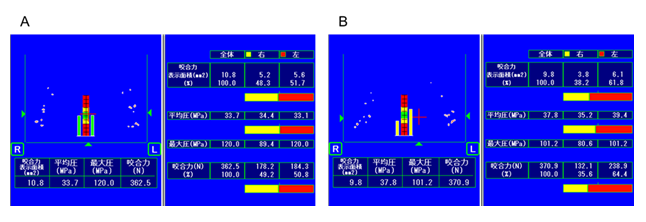
Figure 1: Analysis results of occlusal contact state, using OCCLUZER. A: Occlusal stable group, B: Occlusal unstable group.
Sports tests
The following sports tests were conducted according to the rules of the Nippon Badminton Association: sit-ups, side-steps, 1 min of double jumps, triple jump or five-step jump, and 50-m sprints [3,13]. The triple jump was performed by players aged 12 years or younger, and the five-step jump was performed by players aged 14 years or older.
Statistical analysis
Statistical analysis was performed using SPSS ver. 17.0 (SPSS Japan Inc., Tokyo, Japan) and a P-value below 0.05 was considered significant. The Shapiro–Wilk test was used to examine the normality of distribution and Levene’s test was used for homogeneity of variance. Normality and homogeneity of variance were observed in all age groups.
The differences in occlusal contact area, occlusal force, and scores for each sports test according to gender and occlusal stability were analyzed using two-way analysis of variance and Student’s t-test, respectively. Each analysis was conducted separately for players aged 12 years or younger and for players aged 14 years or older.
Results
Figure 2 shows the difference in occlusal contact area according to gender and occlusal stability. Gender differences were observed in the occlusal stable group of players aged 12 years or younger, with male players having significantly larger occlusal contact area (P<0.01). In players aged 14 years and older, no differences were observed based on gender or occlusal stability.
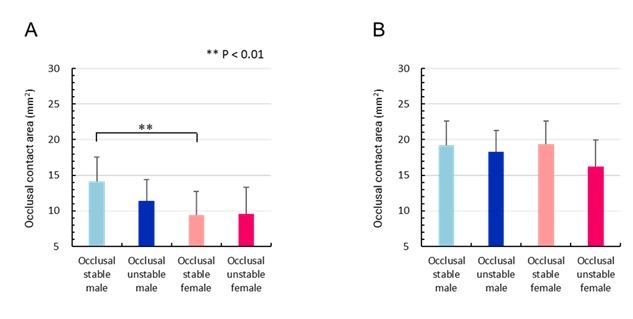
Figure 2: Differences in occlusal contact area depending on gender and occlusal stability. A: Players aged 12 years and under. B: Players aged 14 years and over.
Figure 3 shows the difference in occlusal force depending on gender and occlusal stability. There were no differences in occlusal force due to gender or occlusal stability in players aged 12 years and under and 14 years and over.
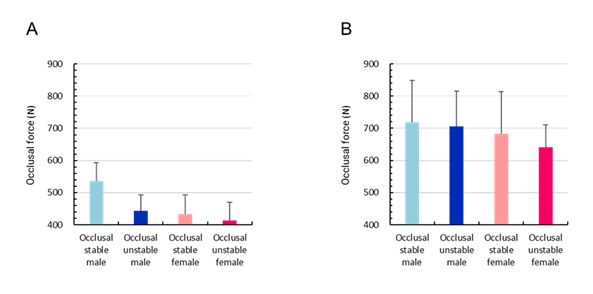
Figure 3: Differences in occlusal force depending on gender and occlusal stability. A: Players aged years 12 and under. B: Players aged 14 years and over.
Figure 4 shows the difference in sit-ups scores according to gender and occlusal stability. For players aged 12 years or younger and those aged 14 years or over, the scores were significantly higher in male players in the occlusal stable group (P<0.05).
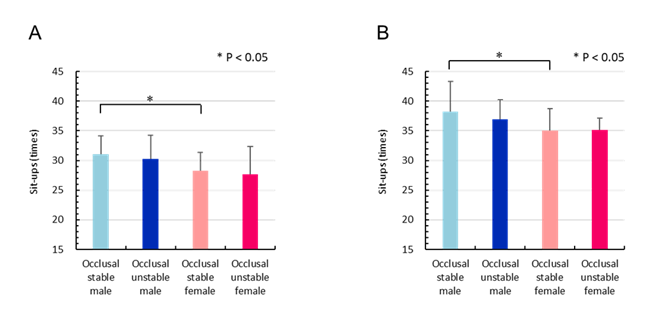
Figure 4: Differences in sit-ups score depending on gender and occlusal stability. A: Players aged 12 years and under. B: Players aged 14 years and over.
Figure 5 shows the difference in side-steps scores based on gender and occlusal stability. Differences by gender were observed in the occlusal stable group for those aged 12 years and under as well as the occlusal stable group and the occlusal unstable group for those over 14 years of age. Among those aged 12 years and under, female players had higher scores, whereas among those aged 14 years and over, male players had higher scores (P<0.01, P<0.05). Differences due to occlusal stability were observed only in players aged 14 years or older, and the scores of the stable occlusal group were significantly higher than those of the unstable occlusal group for both genders (P<0.01, P<0.05).
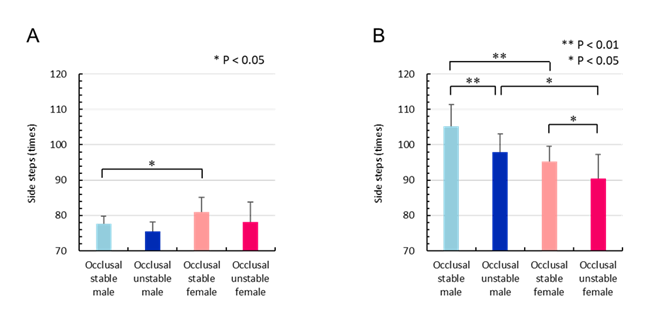
Figure 5: Differences in side-steps score depending on gender and occlusal stability. A: Players aged 12 years and under. B: Players aged 14 years and over.
Figure 6 shows the difference in double jump scores according to gender and occlusal stability. No significant differences were observed in either gender or occlusal stability for players aged 12 years or younger. In players aged 14 years and older, the stable occlusal group had significantly higher scores than the unstable occlusal group for both sexes (P<0.01).
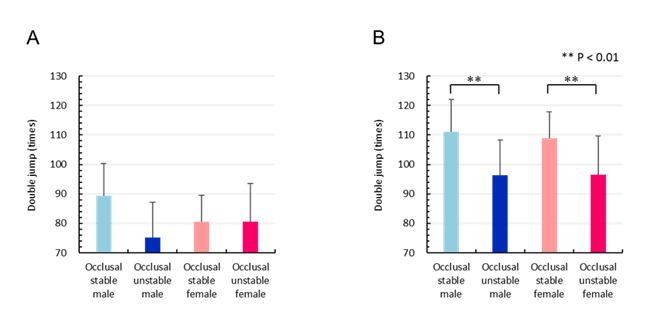
Figure 6: Differences in double jump score depending on gender and occlusal stability. A: Players aged 12 years and under. B: Players aged 14 years and over.
Figure 7 shows the difference in triple jump or five-step jump scores based on gender and occlusal stability. Gender differences were noted in the occlusal unstable group aged 12 years and under, and the occlusal stable and occlusal unstable groups players aged 14 years and over. Among those aged 12 years and under, female players had higher scores, whereas among those aged 14 years and over, male players had higher scores (P<0.01, P<0.05). Differences in occlusal stability were observed only in players aged 14 years or older, and the stable occlusal group had significantly higher scores compared with the unstable occlusal group for both genders (P<0.01, P<0.05).
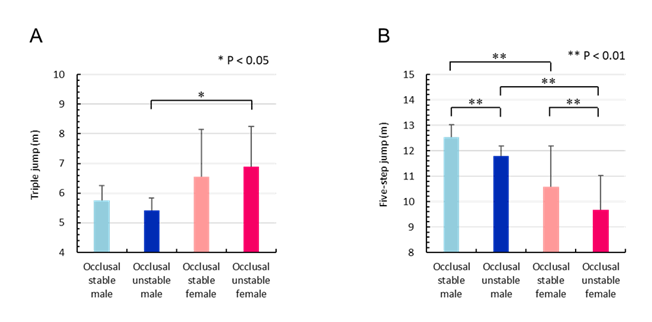
Figure 7: Differences in triple jump or five-step jump score depending on gender and occlusal stability. A: Players aged 12 years and under. B: Players aged 14 years and over.
Figure 8 shows the difference in 50-m sprint scores according to gender and occlusal stability. No significant differences were observed in either gender or occlusal stability for players aged 12 years or younger. Gender differences were observed in players aged 14 years or older, with male players scoring higher in both the occlusal stable group and the occlusal unstable group (P<0.01).
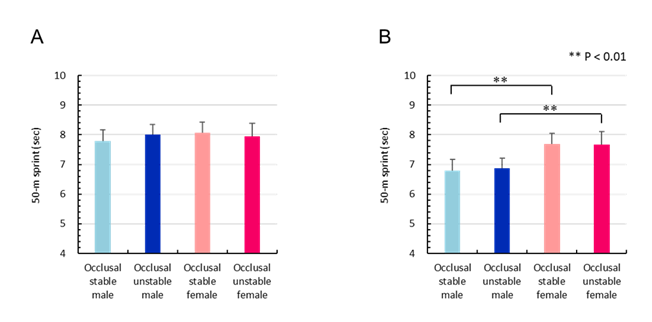
Figure 8: Differences in 50-m sprint score depending on gender and occlusal stability. A: Players aged 12 years and under. B: Players aged 14 years and over.
Discussion
The results of this study revealed that the sports test scores of elite-level junior badminton players are influenced by occlusal stability. In other words, it became clear that among athletes whose molars had fully erupted, those with good occlusal stability had higher scores in side steps, double jump, and five-step jump. Therefore, the null hypothesis was rejected.
The physical fitness test consists of test items that reflect the characteristics of the sport. In other words, martial arts events tend to include tests that emphasize muscle strength, explosive power, and endurance; field sports events tend to include tests that emphasize muscle strength as well as running ability and endurance; and gymnastics events tend to include tests that emphasize flexibility and balance ability. These tests are not only used as a benchmark for identifying elite level athletes but are also used to evaluate athletes’ skills and design training programs [7]. Badminton is characterized by repetitive, agile movements within a relatively narrow space [14]. For this reason, physical functions such as agility, explosive power, and dexterity of the limbs are essential, and endurance and running ability are also involved. The sports tests conducted in this study were sit-ups to evaluate flexibility; side steps to evaluate agility and explosiveness; double jumps to evaluate dexterity; triple jumps and five-step jumps to evaluate agility, explosiveness, and jumping power; and sprints to evaluate running ability [6]. When the measurement time for jump rope is long or the sprint distance is long, the element of endurance becomes more apparent; however, in this study, we selected measurement items for which endurance has little influence, namely, 1-min double jumps and the 50-m sprint, respectively.
Gender differences in sports test scores showed different trends depending on the age category. In the age 14 years and older category, male athletes had higher scores in all tests, whereas in the age 12 years and younger category, female athletes had better scores in the side-steps and triple jump. This is presumably related to the fact that the 12 years and under age category corresponds to the second growth spurt. Although males’ growth spurts occur after the age of 12 years, females’ growth spurts begin at the age of 11 years. For this reason, female athletes probably showed higher scores in tests that evaluate agility, explosiveness, and jumping power, which are physical abilities that utilize the stability of the skeleton and trunk. Dexterity is an ability that develops with age or years of competitive experience, so no differences were observed between levels in the 12 years and under category.
Differences in sports test scores due to occlusal stability were observed in only three items—side steps, double jump, and five-step jump—and were limited to the age 14 years and older category. These results revealed that the sports test scores of athletes whose molars have fully erupted differ depending on the left–right balance of occlusal contact centered on the molars. As shown in Figures 1 and 2, there was no significant difference in the total occlusal contact area or occlusal force depending on occlusal stability, suggesting that left–right balance may have influenced motor function. In addition, the tests in which significant differences were found were those evaluating agility, explosive power, dexterity, and jumping ability, which showed similar trends to a study involving occlusal intervention for handball players [7]. Furthermore, tests evaluating endurance and running ability, in which no significant difference due to occlusal stability was found, showed similar trends to the survey of handball players. This suggests that the influence of occlusal stability on physical function may be due to motor factors rather than the type of competition. However, regarding the differences in test scores for athletes aged 12 and under, no differences were observed in any of the items due to occlusal stability. This suggests that to utilize occlusion for trunk stabilization and cutting movements [4,7,10,15], the stability of the left–right balance of occlusion supported by molars is a prerequisite.
Conclusion
The results of this study revealed that the sports test scores of elite-level junior badminton players are influenced by occlusal stability. It was clarified that among athletes whose molars had fully erupted, those with good occlusal stability had higher scores in side steps, double jump, and five-step jump. This suggests that to utilize occlusion for trunk stabilization and cutting movements, it may be necessary to have a stable left–right balance of occlusion supported by the molars.
Data availability
The datasets collected and/or analyzed during the current study are available from the corresponding author on reasonable request.
Acknowledgments
This work was supported by JSPS KAKENHI Grant Number JP23K10617.
Conflicts of interest statement
The authors have no conflicts of interest relevant to this article.
References
- Balyi I, Way R, Higgs C. Long-term athlete development. Human Kinetics IL (2013).
- Granacher U, Borde R. Effects of sport-specific training during the early stages of long-term athlete development on physical fitness, body composition, cognitive, and academic performances. Front Physiol 8 (2017): 810.
- Nippon Badminton Association: Junior Japanese national selection criteria (2025). Available at: http://www.badminton.or.jp/junior/junior.html
- Takahashi M, Bando Y. Relationship between occlusal balance and agility in Japanese elite female junior badminton players. Int J Sports Dent 11 (2018): 34-42.
- Takahashi M, Bando Y, Fukui T, et al. Equalization of the occlusal state by wearing a mouthguard contributes to improving postural control function. Appl Sci 13 (2023): 4342.
- Bando Y, Takahashi M, Kitayama Y. Relationship between oral function and motor ability of top Japanese junior badminton players: part 1 examination of occlusal force by Dental Prescale. J Sports Dent 21 (2018): 23-30.
- Takahashi M, Bando Y, Kitaoka K, et al. Effect of wearing a mouthguard on physical ability is dependent on occlusal contact state: a study involving elite level female handball players. Dent Res Oral Health 6 (2023): 88-94.
- Takahashi M, Bando Y, Fukui T, et al. Straight jump landing position of trampoline gymnasts with stable occlusal balance reflects standing postural control function. Appl Sci 13 (2023): 6689.
- Takahashi M, Bando Y, Fukui T. Intervention effect of occlusion on the straight jump in trampoline gymnastics: Effect on T-score and H-score. Dent Res Oral Health 8 (2025): 48-52.
- Thomas, WM. Anatomy trains, 3rd Igaku-shoin, Tokyo, Japan 81 (2016): 201-227.
- Itaya A. Feedback system for sensory and postural control. J Biomech 39 (2015): 197-203.
- Bando Y, Takahashi M, Fukui T, et al. Relationship between occlusal state and posture control function of trampoline gymnasts. J Sports Dent 23 (2019): 14-20.
- Bando Y. Healthy teeth lead to the development of motor function. In: Badminton textbook, junior section. Nippon Badminton Association edited. Tokyo: Baseball Magazine Company (2016): 132-145.
- Bando Y. Relationship between accuracy of badminton overhead shots and occlusal contact J Sports Dent 13 (2009): 29-36.
- Boroojerdi B, Battaglia F, Muellbacher W, et al. Voluntary teeth clenching facilitates human motor system excitability. Clin Neurophysiol 111 (2000): 988-993.

 Impact Factor: * 3.1
 Acceptance Rate: 76.66%
  Time to first decision: 10.4 days
  Time from article received to acceptance: 2-3 weeks