
Hepatocellular Cancer, Aflatoxin, and Radiofrequency Radiation
Lennart Hardell
The Environment and Cancer Research Foundation, Örebro, Sweden
*Corresponding Autho : Lennart Hardell, The Environment and Cancer Research Foundation, Örebro, Sweden
Received: 26 October 2025; Accepted: 04 November 2025; Published: 11 November 2025
Article Information
Citation: Lennart Hardell. Hepatocellular Cancer, Aflatoxin, and Radiofrequency Radiation. Fortune Journal of Health Sciences. 8 (2025): 1057-1060.
View / Download Pdf Share at FacebookAbstract
There is sufficient evidence that aflatoxin is a human carcinogen, Group 1, according the International Agency for Research on Cancer (IARC). One of the target organs is the liver with increased risk for hepatocellular cancer. Mill workers may be exposed to aflatoxin e.g. during the processing of imported soybeans.
Methods: In this study, using data from the Swedish 1960 census on occupations and the Cancer Register, 16 mill workers with hepatocellular cancer were identified. Two control groups were used, one group consisted of other mill workers without liver cancer while the other was population based. Four controls in each group were used matched to every case.
Results: Based on work history potential exposure to aflatoxin was no risk factor for hepatocellular cancer, but the results were based on low numbers.
Discussion: After a decline of the incidence of primary liver cancer in Sweden since early 1980s the incidence is increasing since 2006 in women and since 2007 in men. Radiofrequency (RF) radiation is a known human carcinogen, Group 2B, according to the IARC (WHO) evaluation. Handheld devices emitting RF radiation such as laptops and mobile phones may be in close contact with the abdomen and thereby expose the liver to high levels. Animal studies have shown a promotor effect from RF radiation with increased risk for e.g., liver cancer. Exposure to RF radiation is proposed to be a potential contributing factor to the increasing incidence of liver cancer, exhibiting a short latency period consistent with a promoting effect.
Keywords
<p>Liver cancer, aflatoxin, mill worker, radiofrequency radiation</p>
Article Details
Introduction
The incidence of primary liver cancer is high in geographical areas with high concentration of aflatoxin in the food, i.e. parts of Africa and Southeast Asia [1]. In the same regions the prevalence of hepatitis-B virus is high, also a known risk factor for primary liver cancer [2]. Studies in animals have shown that aflatoxin is a potent liver carcinogen [3,4]. Taking into account both aflatoxin and hepatitis B virus infection, studies have indicated these exposures to be independent risk factors for hepatocellular cancer [5].
This article presents previous results on liver cancer in Swedish mill workers with potential exposure to aflatoxin. These results have not been published previously, but may nevertheless be of importance in the evaluation of risk factors among mill workers. The background for this study was an interlinking of the Swedish Census 1960 (FOB 1960) and the Swedish Cancer Register. The Census gives personal information including occupation. For the time period from 1960 until 1979, primary liver cancer among mill workers was found in 14 men and two women.
Materials and Methods
This was a case-control study. The cases consisted of the 16 mill workers that had developed primary liver cancer. All had hepatocellular cancer confirmed by histopathological review. Two sets of controls were selected. Four mill workers without primary liver cancer were selected to each case from the Swedish Census 1960. They were matched on gender and age within five years. The second control group was population based and consisted of four subjects with any other occupation. Also these controls were matched on gender and age in 5 year groups.
Occupations and different exposures were assessed by a questionnaire. If necessary the answers were supplemented by phone by a trained interviewer. Further, regarding mill workers additional information on work and work conditions were obtained from the employers, if possible. Thus, the exposure data relied on the questionnaire, personal interviews, and employers.
The study was initiated by the Swedish National Board of Occupational Safety and Health that also reviewed the ethical aspects on the study.
Results
This is a historical presentation of data that have not been published before. Thus all exposure data were assessed in 1989. Nevertheless since the aim of the study still is considered to be relevant the results deserve to be published.
All 16 cases with liver cancer answered the questionnaire. Of the 64 control subjects that were mill workers without liver cancer, 52 (81 %) answered the questionnaire. Of the population based controls 55 (86 %) participated. Total number of controls was 128 and of these 107 (83.6 %) participated.
Among the 16 cases with primary liver cancer, all of whom were mill workers, only one individual (1.9%) reported potential exposure to aflatoxin during the processing of groundnut feed for animals. Among the 64 control subjects employed in mills, four reported contact with groundnuts. None of the population based controls had any exposure to groundnuts. In total, four control subjects (3.7%) were considered to be exposed to aflatoxin. None of the two female cases and none of their 12 participating controls reported any exposure to aflatoxin. This study did not provide evidence supporting potential exposure to aflatoxin to be a risk factor for hepatocellular carcinoma.
Discussion
Millers may be exposed to aflatoxin while processing groundnuts. Their working conditions may increase the risk for hepatocellular cancer since aflatoxin is a known liver carcinogen [4]. Thus it was pertinent to make an epidemiological study on that issue. The results in this investigation were based on rather low numbers of cases and controls. However, there was no indication that aflatoxin was a major risk factor for hepatocellular cancer in this study. Since before hepatocellular cancer has been associated with hepatitis B virus [6] and alcohol [2]. In our previous study on primary liver cancer an association with alcohol and organic solvents was reported [7]. No case in the current study reported occupational exposure to organic solvents. Most cases had only occasional alcohol intake and no one was a heavy drinker. Thus, based on low numbers no conclusions could be drawn on organic solvents and alcohol as risk factors for hepatocellular cancer. None of the cases in this study reported hepatitis B virus infection.
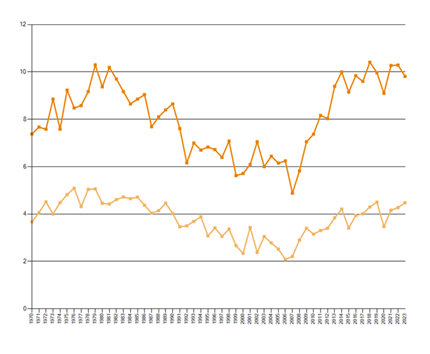
Figure 1: Age-standardized incidence of primary liver cancer (ICD-7 155.0) in Sweden between 1970-2023 for men (top line) and women (bottom line), all ages, according to the Swedish Cancer Register (Statistikdatabaser - Cancerstatistik - Val).
It is of interest that after a decline of primary liver cancer incidence in Sweden since the early 1980s, the incidence is increasing in women since 2006 and in men since 2007, Figure 1. One risk factor to be considered is the increasing use of wireless technology. Figure 2 shows outgoing mobile phone calls in million minutes in Sweden during 2001-2024. The liver may be highly exposed when modern mobile phones, referred to as smartphones, are used for internet browse. The increasing use of RF (radiofrequency) emitting laptops could also expose the liver to high levels. A tumor promoting effect from RF radiation was found in a study on mice at low to moderate levels (0.04 and 0.4 W/kg SAR), which were well below the exposure limits for mobile phones, 2 W/kg (of tissue) to the head [8]. The results in animal studies on the RF radiation carcinogenesis were similar in both the National Toxicology Program (NTP) studies [9,10] and the Ramazzini Institute findings [11]. Equivocal evidence of carcinogenic activity was demonstrated, interpreted as showing a marginal increase of neoplasms that may be test agent related [12-14]. Based on the IARC preamble to the monographs, RF radiation should be classified as Group 1, the agent is carcinogenic to humans [12].
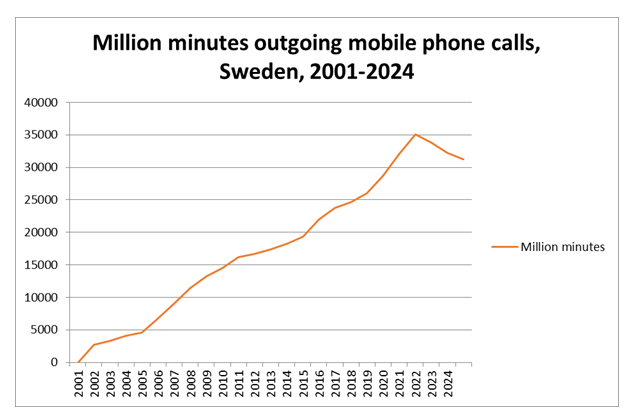
Figure 2: Outgoing mobile phone calls in million minutes in Sweden during 2001-2024. Source: Post och Telestyrelsen, the Swedish Telecommunication Market https://statistik.pts.se/en/telecom-and-broadband/the-swedish-telecommunication-market/
Conclusion
No association between primary liver cancer and aflatoxin was found in this population based study. However, these results were based on low numbers. Interestingly the declining incidence of liver cancer since early 1980’s has been reversed with increasing incidence in women since 2006 and in men since 2007 in Sweden. During the same time exposure to RF radiation has increased. Animal studies have shown a tumor promoting effect, in addition to tumor initiation, from RF radiation. Thus, such exposure should be further investigated as a contributing factor for the increasing incidence of primary liver cancer.
Acknowledgements
The Swedish National Board of Occupational Safety and Health is acknowledged for initiating the study.
Funding
No funding was received
Availability of data and materials
The information generated and analyzed during the current study is available from the corresponding author on reasonable request.
Author’s contributions
The author made conception, design and writing of the manuscript.
Ethics approval and consent to participate
Not applicable
Patient consent for publication
Not applicable
Competing interests
The author declares that no competing interests exist.
Reference
- Linsell CA, Higginson J. The geographic pathology of liver cancer. In: Liver Cell Cancer. Eds. Cameron et al. Oxford: Elsevier Sci. Publ. Co (1976): 1.
- Popper H. Hepatic cancers in man: Quantitative perspectives. Environ Res 19 (1979): 482-94.
- Fong LYY, Chan WC. Long-term effects of feeding aflatoxin contaminated market peanut oil to Sprague-Dawley rats. Food Cosmet Toxicol 19 (1981): 179-83.
- IARC Monographs of the Evaluation of Carcinogenic Risks to Humans. Lyon. France. Supplement 7 (1987): 83-9.
- Peers F, Bosch X, Kaldor J, et al. Aflatoxin exposure, hepatitis B virus infection and liver cancer in Swaziland. Int J Cancer 39 (1987): 545-53.
- Tabor E, Gerety RJ, Vogel CL, et al. Hepatitis B virus infection and primary hepatocellular carcinoma. J Natl Cancer Inst 58 (1977): 1197-200.
- Hardell L, Bengtsson NO, Jonsson U, et al. Aetiological aspects on primary liver cancer with special regard to alcohol, organic solvents and acute intermittent porphyria - an epidemiological investigation. Br J Cancer 50 (1984): 389-97.
- Lerchl A, Klose M, Grote K, et al. Tumor promotion by exposure to radiofrequency electromagnetic fields below exposure limits for humans. Biochem Biophys Res Commun 459 (2015): 85-590.
- National Toxicology Program. NTP technical report on the toxicology and carcinogenesis studies in B6C3F1/N mice exposed to whole-body radio frequency radiation at a frequency (1,900 MHz) and modulations (GSM and CDMA) used by cell phones (2021).
- National Toxicology Program. NTP technical report on the toxicology and carcinogenesis studies in Hsd: Sprague Dawley sd rats exposed to whole-body radio frequency radiation at a frequency (900 MHz) and modulations (GSM and CDMA) used by cell phones. NTP TR 595 (2021).
- Falcioni L, Bua L, Tibaldi E, et al. Report of final results regarding brain and heart tumors in Sprague-Dawley rats exposed from prenatal life until natural death to mobile phone radiofrequency field representative of a 1.8 GHz GSM base station environmental emission. Environ Res 165 (2018): 496-503.
- Hardell L, Carlberg M. Comments on the US National Toxicology Program technical reports on toxicology and carcinogenesis study in rats exposed to whole-body radiofrequency radiation at 900 MHz and in mice exposed to whole-body radiofrequency radiation at 1,900 MHz. Int J Oncol 2019 (2019): 111-27.
- Hardell L. Nilsson M, Koppel T, et al. Aspects on the International Commission on Non-Ionizing Radiation Protection (ICNIRP) 2020 guidelines on radiofrequency radiation. J Cancer Sci Clin Ther 5 (2021): 250-83.
- International Commission on the Biological Effects of Electromagnetic Fields (ICBE-EMF). Environ Health 21 (2022): 92.

 Impact Factor: * 6.2
 Acceptance Rate: 76.33%
  Time to first decision: 10.4 days
  Time from article received to acceptance: 2-3 weeks